ABDM and ABHA, explained in 5 minutes.
Every clinic owner has heard the acronyms. Most have no idea what they mean operationally. Here is the version we'd give over chai.
What is ABDM, actually?
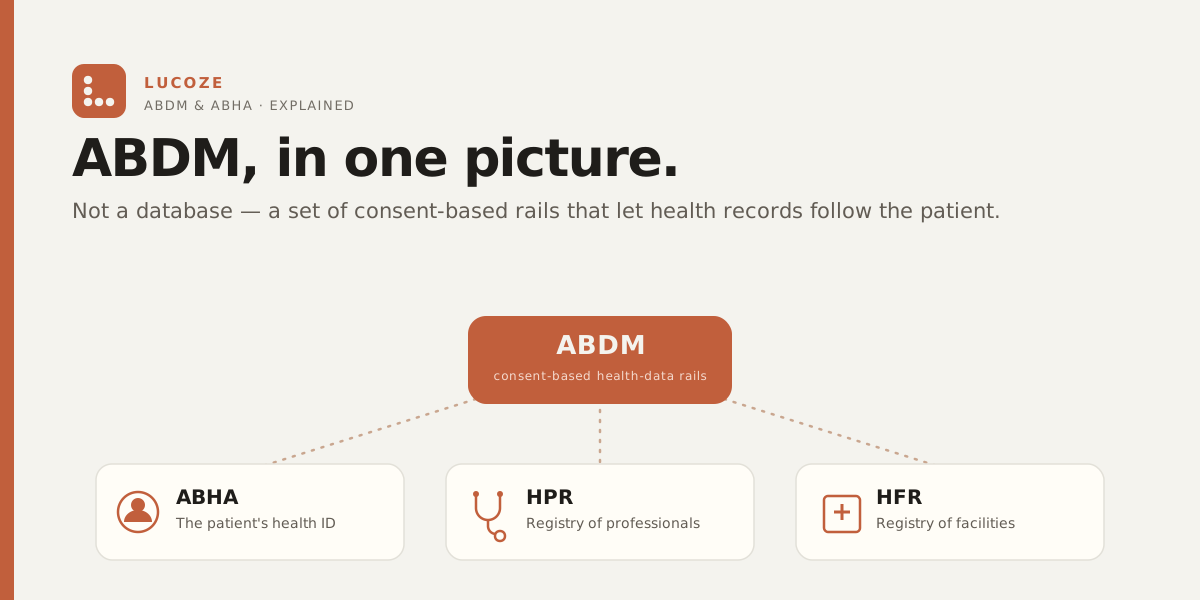
ABDM stands for the Ayushman Bharat Digital Mission — the National Health Authority’s framework for letting Indian health records flow between providers, with the patient’s consent, on standard rails. It is not a database. It is a set of agreements about how databases talk to each other.
Three things make it real:
- An ID for the patient — ABHA (Ayushman Bharat Health Account), a 14-digit number.
- An ID for the provider — the Healthcare Professional Registry (HPR) and Health Facility Registry (HFR).
- A consent layer — the patient grants and revokes access per provider, per visit.
What is ABHA, in plain language?
ABHA is the patient’s lifelong health ID. It is created by the patient — not the hospital — in under 90 seconds via the ABHA app or the ABDM portal, with mobile + Aadhaar (optional). It comes in two forms the front desk should tell apart — a 14-digit ABHA number and an ABHA address.
Behind the ID is consent-based access to past records. The patient grants permission per provider, per visit. Hospital A can read what Hospital B wrote, but only if the patient said yes.
The records stay where they were created. ABHA is the index. Nothing moves until the patient moves it.
What are HPR and HFR?
HPR is the registry of healthcare professionals — doctors with verified medical council registration numbers. HFR is the registry of health facilities — hospitals, clinics, diagnostic centres with verified addresses. Both are public, both are queryable.
The moment a provider is HPR-registered and the facility is HFR-registered, your clinic can issue ABHA-linked records and verify other providers. Setup takes about an hour per doctor.
Why does this matter in 2026 (and not in 2024)?
Three things changed:
- Several state insurance schemes have moved to ABHA-linked claims processing. Without it, you are filing on paper.
- PMJAY claims at NABH-empanelled hospitals are increasingly ABHA-linked. The threshold of “optional” is being pulled back.
- The Unified Health Interface (UHI) lets cross-clinic referrals work — a derm clinic in Lucknow can refer to a tertiary centre in Kolkata, with consent, without a fax.
What should a clinic do now?
Two things, in order:
- Get the facility registered on the HFR. The doctors HPR-registered. ~60 minutes total.
- At first visit, offer to create or link ABHA for the patient. Most patients say yes; the few who don’t, you skip without friction.
If your software vendor can’t do both of these natively, ask when. If they can’t answer — that’s your answer.
What ABDM is not
It’s not a national medical record system. It’s not a government database of your patient’s data. It’s not a mandate that you upload anything — records stay with the provider that created them. It’s not a substitute for your EMR — your EMR has to support ABDM. The two work together.
Official sources
- Ayushman Bharat Digital Mission (ABDM) — the National Health Authority’s official portal.
- National Health Authority (NHA)— the body that publishes the ABDM/ABHA/HPR/HFR standards and APIs.
Next steps
If you want to walk through ABHA setup for your specific clinic, we are happy to help — no pitch attached. Reach out.