Corporate panels, camps, and credit patients: billing the payers who aren't insurers.
Not every payer is a patient or a TPA. Employers, camps, and credit accounts bring volume but bill on their own rhythm — and that's where receivables quietly pile up.
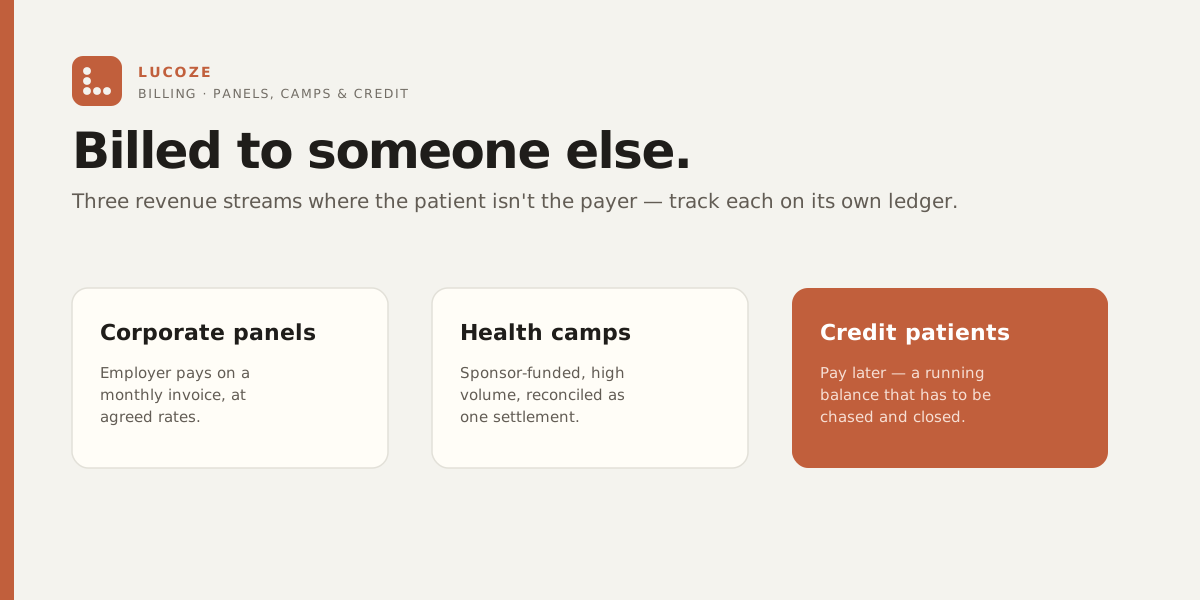
Insurance gets all the attention, but a lot of a clinic’s revenue comes from payers who aren’t the patient and aren’t a TPA: a company that sends its employees, a health camp that converts into follow-ups, a local organisation with a running credit account. These channels bring steady volume — and they’re where receivables quietly pile up, because nobody bills a company the way they bill a walk-in. This is a practical look at the payers between “cash patient” and “insurance claim,” and how to keep their money from ageing.
How is corporate billing different from a normal bill?
A corporate tie-up — a company that sends staff for consultations, health checks, or treatment on an agreed rate — isn’t billed patient-by-patient in cash. It’s billed to the organisation, usually on a periodic statement, often at negotiated rates that differ from your rack card. That introduces three things a cash bill doesn’t have:
- A rate agreement. The company pays contracted prices, not counter prices. If your billing can’t hold a separate rate card per panel, staff either apply it by memory (and get it wrong) or bill full rate (and trigger disputes).
- A billing cycle. The organisation pays monthly or on a cycle, against a consolidated statement — not at the point of care. Every visit in between is a receivable.
- An approver. Someone on the company side signs off. Statements that don’t match their records bounce back, and the cycle slips another month.
Do health camps actually make money?
A camp rarely pays for itself on the day — its value is the follow-up: the screening that surfaces a condition, the patient who comes back to the clinic. But that only shows up in the books if the link is captured. A camp run as a stack of paper forms produces a pile of names and no way to tell which converted into a paying visit. Captured properly — camp as a source, each registration tied to the patient record — you can actually see the return: how many came back, what they were billed, whether the camp was worth running again. Without that thread, “the camp went well” is a feeling, not a number.
Why do credit patients age the worst?
Credit is the easiest revenue to give and the hardest to collect. Every “we’ll settle it later” is a loan your clinic made without meaning to.
Credit accounts — a local institution, a trust, a known family billed on account — are convenient and dangerous in equal measure. Convenient because they keep valued patients flowing; dangerous because an untracked credit balance grows silently until it’s a write-off. The problem is almost never the individual bill. It’s the absence of a running ageing view: which accounts owe what, how old the balance is, which have crossed from “recent” into “chase now.” A clinic that can pull an ageing statement per account collects; one that can’t discovers the exposure only when it needs the cash.
What ties these payers together?
Corporate panels, camps, and credit accounts look like three different problems, but they share one fix: each is a payer that isn’t settling at the counter, so each needs to be tracked as a receivable with a rate, a cycle, and an ageing clock. That’s the same reconciliation discipline insurance claims need — a running view of what’s owed, by whom, and for how long — just pointed at non-insurer payers. It’s also the leak the homepage ROI estimate is pointing at when it counts “partial payments untracked”: money earned, not yet collected, quietly ageing.
Lucoze is built to carry panel rate cards, credit accounts, and camp sources in the same ledger as cash and insurance billing, so a company statement or a credit balance is a tracked receivable with an age — not a favour someone has to remember. For how the pieces reconcile into one day’s collection, see the clinic billing stack; for the billing module itself, start there.
If it isn’t tracked, it isn’t collected
The payers who aren’t insurers — employers, camps, credit accounts — are real revenue on a slower clock. They pay if someone is watching the receivable and sending the statement; they age into write-offs if no one is. If you want to look at where your non-cash, non-insurance billing is sitting, get in touch — no pitch attached.