GST for clinics, hospitals and doctors in India (2026)
Is GST applicable to clinics and hospitals? Where healthcare is exempt, and where GST actually hits: pharmacy, room rent, cosmetic work and diagnostics.
This is general information for clinic owners, not tax advice — how GST applies turns on your exact facts, so run specifics past a qualified CA or GST practitioner. Official sources are linked at the end.
The short version
If you run a clinical establishment in India, most of what you charge for — consultations, diagnosis, treatment, in-patient care — is GST-exempt. That surprises a lot of owners who assume “GST applies to everything now.” It doesn’t apply to core healthcare.
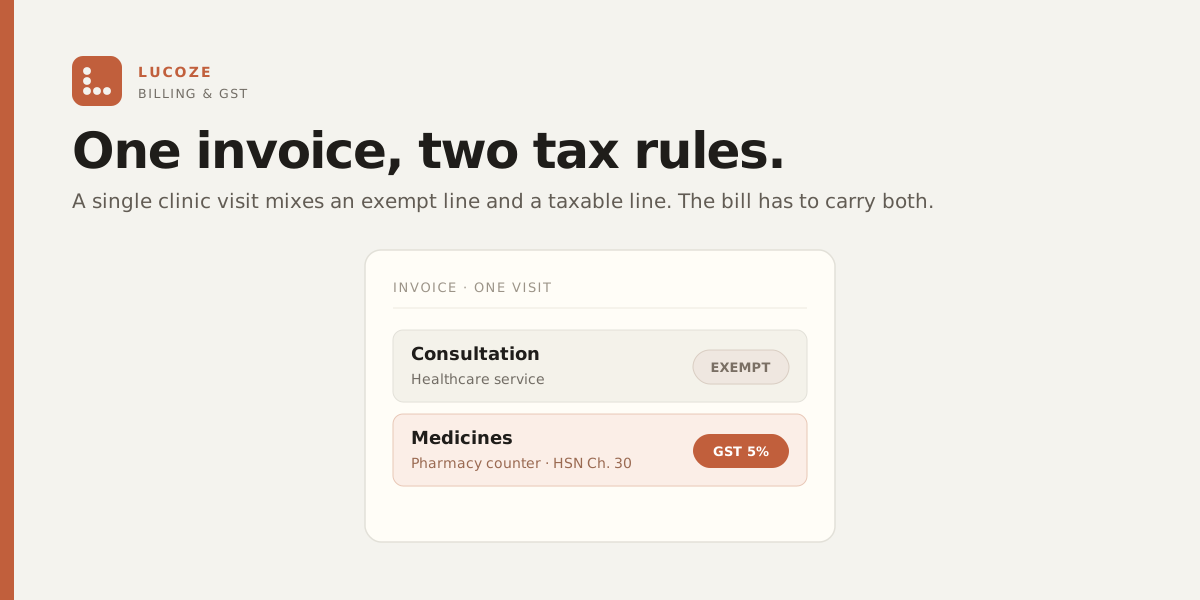
The catch is that a clinic rarely sells only core healthcare. The moment you also run a pharmacy counter, a canteen, a cosmetic service, or bill high-end room rent, you’ve stepped into taxable territory — and a single patient’s bill can carry both exempt and taxable lines at once. Getting the split right on every invoice is the whole game.
What healthcare services are GST-exempt?
Under the GST exemption for healthcare, services by a clinical establishment, an authorised medical practitioner, or paramedics are exempt. In plain terms, the diagnosis, treatment or care of an illness, injury, deformity or abnormality — delivered by your clinic or your doctors — does not attract GST. This is set out in CBIC’s core healthcare exemption, Notification No. 12/2017-Central Tax (Rate) (as amended).
Broadly, this covers:
- Doctor consultations and follow-ups.
- Diagnosis, treatment and the clinical procedures that go with it.
- In-patient care and the services bundled into it.
- Transport of a patient in an ambulance, and services by paramedics — these are generally treated as part of the exempt healthcare envelope.
The exemption is about therapeutic care. That single word is where most of the taxable edge cases come from.
Where does GST usually apply in a clinic?
These are the activities that sit next to healthcare but fall outside the exemption. If you do any of them, GST typically enters the picture:
- Retail pharmacy / medicine sales to walk-ins. Selling medicines and consumables over the counter to the public is a supply of goods, not healthcare. It’s generally taxable. (Medicines and implants administered to an admitted in-patient as part of treatment are usually treated as part of the exempt care — but the retail counter is a sale. This distinction trips people up; get it confirmed for your setup.)
- Purely cosmetic or aesthetic procedures. Cosmetic and plastic surgery that isn’t therapeutic — done to enhance appearance rather than to reconstruct or restore anatomy affected by a congenital defect, trauma, injury or the like — is specifically outside the healthcare exemption, and taxable.
- Food, canteen and cafeteria sales. Running a canteen or selling food to visitors is a separate taxable supply (in-patient diet provided as part of care is a different question — again, verify).
- Room rent above a notified per-day threshold. A well-known CBIC notification from July 2022 (effective 18 July 2022) made hospital room rent above a per-day limit taxable — widely reported as above ₹5,000 per day, and specifically excluding ICU / CCU / ICCU / NICU. As of 2026 this is the structure, though the per-day figure has been revised before.
- Sale of equipment and goods. Selling devices, equipment, or other goods is a supply of goods and generally taxable like any other trade.
Notice the pattern: the exemption protects care. The moment a line item is really a sale of goods or a non-therapeutic service, the shelter usually drops away.
Do you need to register for GST?
GST registration is turnover-based. Once your aggregate turnover crosses a notified threshold, registration becomes mandatory (as of 2026, ₹20 lakh for service providers — lower in some special-category states, higher for a pure supply of goods).
Here’s the part clinics miss: exempt turnover still counts toward aggregate turnover. A clinic that is 95% exempt healthcare but runs a taxable pharmacy or canteen can still be pushed over the line and required to register — and then charge, collect and remit GST on its taxable supplies while its core healthcare stays exempt. “We’re a hospital, we don’t do GST” is not a safe assumption once there’s a counter at the front.
This also interacts with things like TPA and insurance claim workflows, where the composition of a bill matters for what gets reimbursed and how it’s documented. Keep the tax treatment clean from the start and those downstream processes get easier.
Hospitals, doctors and diagnostic centres — where each stands
The exemption is written around the service, not the label on the door, so it lands slightly differently for each:
- Hospitals: in-patient treatment, the room and standard clinical care are exempt; GST shows up on the pharmacy counter, the canteen, and any commercial or purely cosmetic services. Most of the bill is exempt — rarely all of it.
- Doctors: a doctor providing clinical care is supplying exempt healthcare, so pure practice attracts no GST, and most individual practitioners never cross the registration threshold on healthcare alone. GST registration is triggered only when taxable side supplies — a pharmacy, aesthetic procedures, other consulting income — cross the limit.
- Diagnostic centres and labs: diagnostic services by a clinical establishment are exempt healthcare too — the tests themselves aren’t taxed. GST still applies to anything sold alongside that isn’t a diagnostic service.
The through-line: the clinical service is exempt for all three; GST enters through the non-clinical things sold next to it. Confirm the specifics for your exact mix with a CA.
Can a clinic claim input tax credit?
One nuance worth flagging: when your output supply is exempt, the GST you pay on related inputs is generally not fully available as input tax credit. The CGST Act’s credit-apportionment rules (Section 17) restrict ITC attributable to exempt supplies, so a mostly-exempt clinic can’t simply reclaim all the tax on everything it buys. Where and how much you can claim is a genuinely technical question — this is exactly the kind of thing to hand to your CA rather than guess at.
Why is GST really a billing problem?
Step back and the compliance question becomes an invoicing question. On any given visit, a patient might be charged for a consultation (exempt), a strip of medicine from your pharmacy (taxable), and a room night (taxable or exempt depending on the rate). That’s one bill, three different tax treatments.
If your billing system can’t tag each line item’s treatment correctly — exempt vs taxable, and at the right rate where taxable — you end up either over-charging patients, under-remitting to the government, or reconstructing the split by hand at return time. All three are avoidable. This is why we treat it as a structural feature, not an afterthought: Lucoze’s billing is built to tag exempt vs taxable line items on the same invoice, so a consultation and a medicine sale can co-exist on one bill without you doing the tax logic in your head. (We’re early-stage and working with design partners — so that’s how it’s built to work, not a claim about how many clinics run it today.)
The tax treatment is only one layer of the bill, though. How it all fits together — pharmacy, packages, discounts, receipts, reconciliation — is the wider picture we walk through in the clinic billing stack.
Sources
- CBIC — GST portal (cbic-gst.gov.in) — the official source for GST law, rate and exemption notifications, and circulars. The healthcare exemption and the room-rent and cosmetic-surgery treatment all trace back to notifications published here.
- GST portal (gst.gov.in) — registration, returns, and the aggregate-turnover thresholds that decide whether you must register.
If you’re trying to work out where your clinic’s services fall — and how your invoices should be structured so the exempt-vs-taxable split is right by default — that’s a conversation worth having with your CA first, and then with whoever builds your billing. If it helps to talk through the software side, reach out. No pitch attached.