Pharmacy billing and GST: Schedule H, HSN, and getting the invoice right.
A clinic pharmacy sits at the awkward seam where drug law and tax law meet. Here's what has to be on the invoice, and why a general 'health services are exempt' assumption gets pharmacies in trouble.
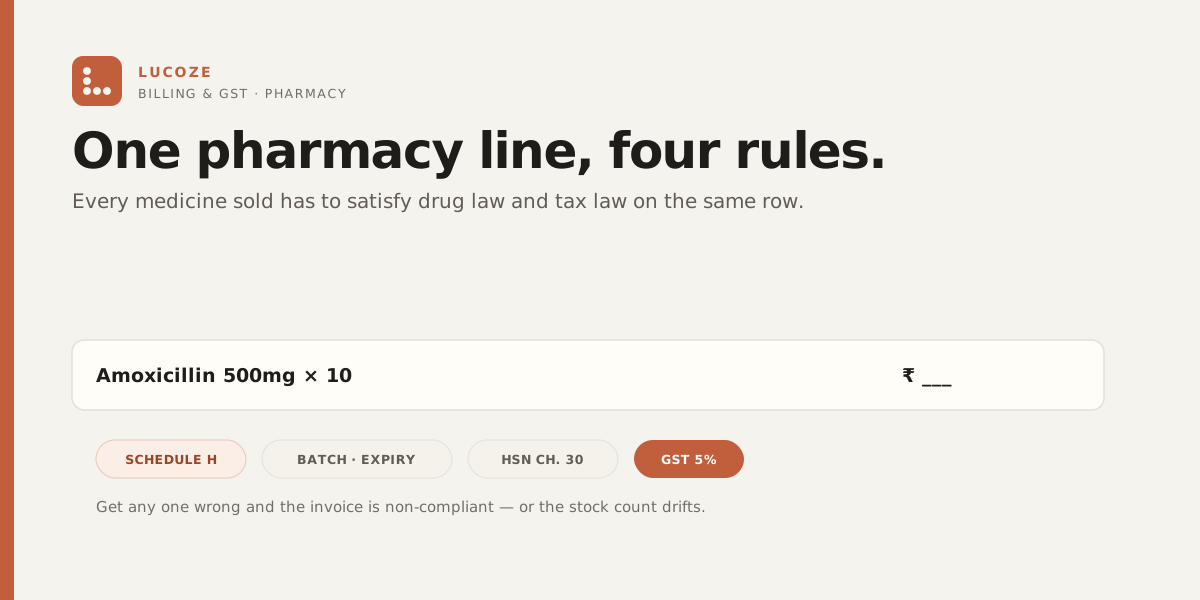
Most clinic owners know two things about GST and healthcare: that health services are largely exempt, and that their pharmacy still charges tax. Those two facts sit uncomfortably next to each other, and the pharmacy counter is exactly where the seam shows. A pharmacy invoice has to satisfy drug law and tax law at the same time — and the two were written by different people for different reasons. This is a practical walk through what belongs on the invoice and where the common assumptions go wrong. It’s general information, not tax or legal advice — run specifics past your CA.
Why isn’t pharmacy exempt if healthcare is?
The exemption most people remember applies to health-care services — a doctor treating a patient. A pharmacy selling medicines and consumables over the counter is a supply of goods, and goods are taxable unless specifically exempt. So an outpatient walking up to buy a strip of tablets is a taxable sale, GST and all.
The genuinely tricky case is medicines supplied to an admitted patient as part of treatment. Several advance rulings have treated in-patient medicines and consumables as part of a single composite health-care service, and therefore exempt — but this is fact-specific and has been litigated both ways. Don’t generalise from a headline. Where your outpatient pharmacy and your in-patient supply are billed differently, that difference has a reason, and your CA should sign off on it. Our GST for clinics and hospitals guide covers the exempt/ taxable line for the clinic as a whole; this post is about the counter.
What is HSN, and what rate do medicines carry now?
HSN (Harmonised System of Nomenclature) is the code that tells the tax system what a product is. Most pharmaceuticals fall under HSN Chapter 30, but the exact code — and the GST rate that rides on it — varies by formulation. A GST-registered seller above the prescribed turnover has to show HSN on the invoice, and the number of digits required scales with turnover.
The rates changed materially under GST 2.0. On the 56th GST Council’s recommendation, from 22 September 2025 most drugs and medicines moved from the 12% slab to 5%, while a specified set of life-saving drugs was cut to Nil (33 drugs from 12% to nil, plus three cancer/rare-disease drugs from 5% to nil). So the working picture today: 5% on the great majority of formulations, nil on the notified life-saving list, with non-medicine counter items (cosmetics, some devices, general goods) sitting higher on their own HSN.
The practical point survives the rate change: the rate is HSN-specific, not “pharmacy-specific.” If your billing treats “the pharmacy” as one flat rate you’ll mis-tax part of the shelf — the nil-rated life-savers or the higher-rated non-medicines — and it surfaces at return time. Your billing has to carry the right rate per HSN line, not one flat pharmacy rate.
Where does Schedule H come in — isn’t that drug law, not tax?
It is drug law, and it lives on the same invoice, which is why pharmacies conflate the two. Under the Drugs and Cosmetics Rules, prescription-only medicines are grouped into schedules:
- Schedule H — prescription-only drugs. Dispensed against a valid prescription, with the sale recorded.
- Schedule H1 — a subset (certain antibiotics, some habit-forming drugs) with extra record-keeping: a dedicated register capturing the drug, quantity, prescriber, and patient, retained for the period the rules require.
- Schedule X — the most tightly controlled (narcotic and psychotropic categories), with stricter storage, a separate register, and prescription-retention rules.
None of this changes the GST on the line, but it changes what your system has to capture at the point of sale — a prescriber, a patient, a batch, an expiry — and hold for inspection. A counter that captures GST but not the H1 register is compliant with the tax man and exposed to the drug inspector. Getting both from one entry, rather than a bill on the computer and a register in a notebook, is the whole point of running the pharmacy on the same system as the clinic.
Why do batch and expiry belong on the bill?
Beyond law, batch and expiry are where pharmacy money leaks. Stock bought and never sold before expiry is a straight write-off; stock sold without recording the batch can’t be traced in a recall. A pharmacy that bills by batch — oldest-expiry-first, expiry visible at the counter — converts “we found expired stock during stock-take” into “the system flagged it a month out.” That is inventory discipline, not heroics, and it is exactly the kind of quiet leak the pharmacy module is meant to close. Lucoze is built to track Schedule-H/H1/X dispensing, batch, and expiry from the same sale that produces the GST invoice, so the compliance record and the tax record come from one action instead of two.
Do we need e-invoicing for the pharmacy?
E-invoicing — reporting B2B invoices to the government portal to get an IRN before issuing them — is mandatory once a business crosses the aggregate-turnover threshold. Since 1 August 2023 (CBIC Notification 10/2023-Central Tax) that threshold is ₹5 crore: if your aggregate turnover crossed ₹5 crore in any financial year from 2017-18 onward, e-invoicing applies to your B2B supplies and exports. Note “aggregate” — it’s your total turnover across the whole GSTIN/entity, not the pharmacy in isolation, so a hospital with pharmacy, lab, and OPD revenue can cross the line without any single counter looking large.
Two more things worth knowing: businesses with turnover of ₹10 crore or more must report invoices to the IRP within 30 days of the invoice date (effective 1 April 2025) — miss the window and the IRN can’t be generated. And B2C counter sales are a separate regime (dynamic-QR rules) with their own thresholds. If you’re near ₹5 crore, that’s a question for your CA now, not at the next audit — and your billing should be able to switch e-invoicing on when you cross the line without re-platforming.
Sources
- GST Council — recommendations of the 56th meeting (3-4 Sep 2025): drugs/medicines 12% → 5%, a notified life-saving list to nil, effective 22 Sep 2025.
- CBIC (GST) — the official rate finder and notifications (incl. Notification 10/2023-Central Tax setting the ₹5 crore e-invoicing threshold from 1 Aug 2023); the rate for a specific HSN is here.
- CDSCO — the Drugs and Cosmetics Act/Rules, which define Schedule H, H1, and X and their record-keeping.
One entry, two rulebooks satisfied
A clinic pharmacy has to answer to the drug inspector and the GST return from the same shelf. The pharmacies that stay clean don’t do it with more paperwork — they do it by capturing everything the sale needs once: the schedule and register, the batch and expiry, the correct HSN and rate. If you want to walk through how your pharmacy’s billing and stock are set up, reach out — no pitch attached.