Getting paid under PMJAY and state health schemes.
Government schemes cover a large share of patients in East India — and they run on their own rails. Package rates, pre-auth, and ABHA linkage decide whether the money arrives or ages.
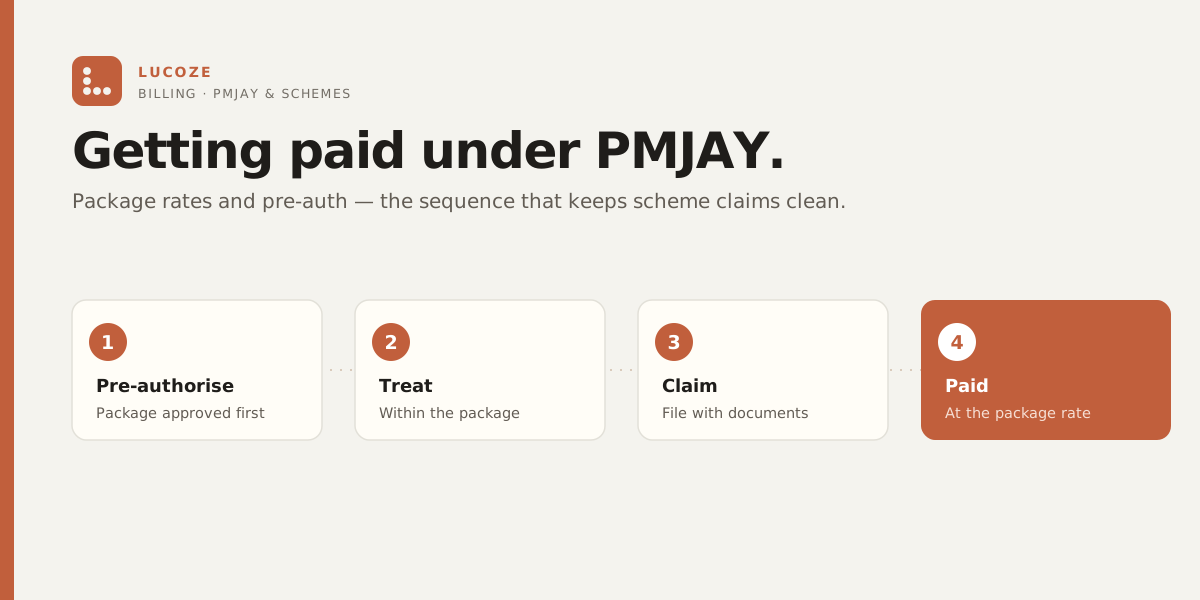
For a lot of small hospitals and nursing homes in eastern India, government schemes aren’t a side stream — they’re a large part of the patient book. PMJAY and the various state schemes bring volume, but they pay on their own terms: fixed package rates, their own pre-authorisation, their own portal, and increasingly their own dependence on digital identifiers. Treat them like private insurance and you’ll be surprised at what lands in the account. This is a practical, vendor-neutral walk through how scheme money actually moves. Rates and rules differ by scheme and state — your State Health Agency’s guidelines govern the specifics.
What does empanelment actually get you?
You can only bill a scheme if your facility is empanelled for it — approved by the State Health Agency (SHA) that runs PMJAY in your state, plus separate empanelment for any state scheme. Empanelment defines which package categories you’re allowed to treat and claim (a facility approved for general surgery isn’t automatically approved for cardiology), and it’s tied to your infrastructure and, often, your accreditation status. It is not a one-time badge: renewals, inspections, and category changes all touch what you can bill, so the empanelment status is operational data, not a certificate in a drawer.
Why is package pricing so different from private billing?
Private insurance largely pays against an itemised bill. Schemes mostly pay a fixed package rate — a defined amount for a defined procedure under the Health Benefit Package (HBP) master, regardless of what your itemised cost came to. That flips the economics:
- The package is the ceiling. If your actual cost runs over, the gap is yours, not the scheme’s. Case selection and length-of-stay discipline matter more than they do on a fee-for-service claim.
- Picking the right package is the claim. Choose too low and you under-recover; choose wrong and it’s queried or rejected. The package master is large and periodically revised.
- Accreditation lifts the rate — measurably. Under NHA norms, a PM-JAY hospital with entry-level NABH is paid 10% above the base package rate, and one with full NABH 15% above. These stack with other incentives (aspirational-district, teaching-hospital), so accreditation is one of the most concrete reasons a small hospital pursues NABH readiness — it pays for itself in the package rate.
How does pre-authorisation work on the scheme portal?
Like cashless private claims, PM-JAY treatment runs through a pre-authorisation, raised on the National Health Authority’s Transaction Management System (TMS). The hospital’s Arogya Mitra verifies the beneficiary, then raises the case with the chosen package, diagnosis, and supporting documents; the State Health Agency reviews it and, for planned admissions, is expected to respond within a defined window (emergencies proceed and are authorised around care). The failure modes echo private insurance — a diagnosis that doesn’t match the package, documents that don’t support the procedure, an approval treated as a formality — but the portal and the rules are the scheme’s own. The discipline that keeps private claims clean, covered in our TPA and insurance claims guide, transfers directly; only the counter changes.
Where do ABHA and ABDM fit into scheme billing?
Beneficiary verification increasingly leans on digital identifiers, and scheme records tie into the broader ABDM plumbing. If your facility can create and link an ABHA cleanly at the front desk, verification and record-linking are one less place a case stalls. This is where scheme readiness and ABDM readiness stop being separate projects: the same registration hygiene that makes you “ABDM-ready” removes friction from scheme intake. If that plumbing is new to you, start with the ABDM and ABHA guide and the front-desk ABHA workflow.
Why does scheme money age, and what stops it?
Scheme claims rarely fail loudly. They go quiet — approved, treated, submitted, and then sitting in a queue no one is watching until a cash crunch forces a look.
The receivable problem is the same shape as private insurance, just at scheme scale. A pre-auth raised but not converted to a claim, a claim submitted but short-settled against the package, a query that expired unanswered — each is a small leak, and volume multiplies it. What stops it is a running view of every scheme case by status: pre-auth raised, approved, patient discharged, claim submitted, paid, reconciled. Lucoze is built to carry a case through that lifecycle so a stuck scheme claim surfaces as a task, not as a surprise at quarter-end. The technology doesn’t replace the person who follows up — it makes sure they’re following up on the right ten cases instead of auditing three hundred.
Sources
- National Health Authority (NHA) — the apex body for AB PM-JAY; publishes the operation manual, the Health Benefit Package master, and the NABH-linked package incentives (entry-level +10%, full +15%).
- Ayushman Bharat PM-JAY — the scheme portal for beneficiary verification, empanelment, and the Transaction Management System (TMS) where pre-auth and claims are raised.
- Your State Health Agency (SHA) — runs empanelment, package approvals, and payment in your state; scheme specifics (rates, TAT, state schemes) are set here.
Volume only helps if it gets paid
Government schemes can fill a small hospital’s beds, but the margin lives in the details: the right empanelled packages, a clean pre-auth, ABHA-smoothed intake, and someone watching the receivables. None of it is dramatic; all of it is trackable. If you want to walk through where your scheme claims are getting stuck, get in touch — no pitch attached.