TPA and insurance claims: getting paid without the chase.
Cashless and reimbursement claims are where clinic revenue quietly leaks. Here's the workflow that keeps money moving instead of ageing on a spreadsheet.
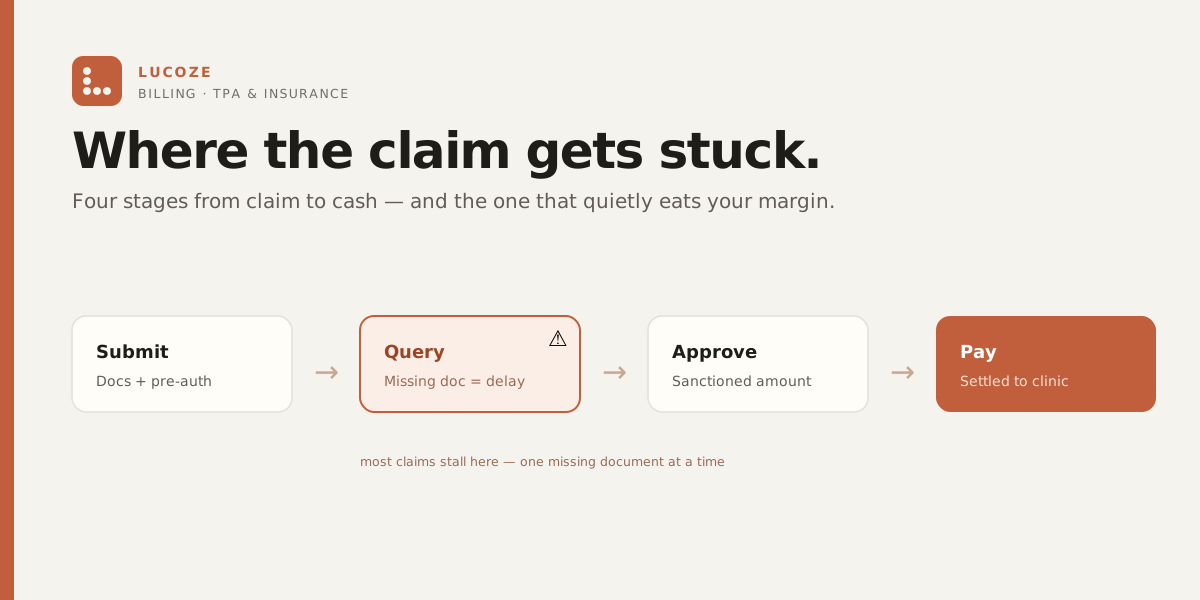
For most clinics and small hospitals, the hardest part of insurance isn’t the medicine — it’s getting paid for it. A claim that should settle in weeks sits unpaid for months because a document was missing, an approval never came, or nobody was tracking it. This is a practical walk through the workflow, vendor-neutral, so you can see where the leaks are before they cost you.
What are the two ways a claim happens?
Every insured patient reaches you on one of two tracks, and the paperwork differs:
- Cashless. The patient doesn’t pay for covered treatment; the insurer (usually through a Third Party Administrator, the TPA that processes claims on the insurer’s behalf) settles directly with you. This is smoother for the patient but puts the documentation and follow-up burden on the clinic.
- Reimbursement. The patient pays you up front, then claims the amount back from their insurer themselves. Your job is to hand them a clean, complete set of documents. If your bill or discharge summary is sloppy, the patient’s claim gets queried — and you get the angry phone call.
Either way, the money only flows if the paperwork is right. The difference is who chases it.
Why does pre-authorisation come first?
For cashless treatment, the single most important step happens before or at admission: pre-authorisation. You send the TPA the patient’s details, the proposed treatment, and an estimate, and they approve a covered amount before care proceeds (for planned procedures) or shortly after (for emergencies).
Skip or fumble this and the whole claim is at risk. The common failures are predictable: the estimate doesn’t match what actually gets done, the diagnosis on the request doesn’t match the final one, or the approval amount is treated as a guarantee when it’s really a ceiling. Get the pre-auth right and clean, and you’ve removed most of the reasons a claim gets rejected later.
Which documents must be right?
Claims live or die on documentation. The exact list varies by insurer and TPA, but the spine of it is consistent — and every item has to be internally consistent with the others:
- Patient identity and policy details — name, policy number, and the ID the insurer needs, all matching what’s on the card.
- Diagnosis — clearly stated and consistent from pre-auth through discharge. A diagnosis that shifts between documents is a query waiting to happen.
- Itemised bill — line-by-line charges, not a lump sum. Insurers pay against the itemisation, and anything they can’t map to their tariff, they’ll question.
- Discharge summary — the clinical narrative that ties the diagnosis, treatment, and stay together. This is the document TPAs scrutinise most.
None of this is exotic. The failures are almost always mundane — a mismatch, a missing signature, a number that doesn’t add up — caught late, when the patient has left and the file is cold. Getting the billing itemisation clean at the point of care is where a proper billing system earns its keep; it’s also where GST on your invoices and claim documentation have to line up rather than fight each other.
Why do claims come back after submission?
Once care is done, the claim goes to the TPA or insurer with the full document set. Then you wait — and often, it comes back queried or rejected. The recurring reasons are worth knowing because most are preventable:
- Missing or incomplete documents. The most common and the most fixable — a report, a signature, or a page nobody attached.
- Non-disclosure. A pre-existing condition or history the insurer says wasn’t declared. This is between patient and insurer, but it stalls your payment.
- Tariff mismatch. A charge above the agreed rate for that procedure or room category. The insurer pays their tariff, not yours, and disputes the gap.
- Delayed submission. Claims and documents have submission windows. Miss them and an otherwise valid claim can be rejected outright on timing alone.
A rejected claim isn’t always a lost one — most are queries you can answer. But only if someone is watching the file. An unwatched query becomes a write-off by default.
Why do claims age on your books?
Here’s where the real money leaks. You submit a claim, and then… nothing. It’s not rejected, not paid — it’s just sitting there. Multiply that by every insured patient and you have a growing pile of receivables ageing on the books, weeks turning into months, cash you’ve earned but can’t spend.
The problem is rarely any single claim. It’s that no one has a running view of all the claims: which are approved, which are queried and awaiting a response, which were paid short and need reconciling against what you billed, and which have simply gone quiet and need a follow-up call. Without that view, claims don’t get chased until a cash crunch forces a panicked audit — and by then some are past their window.
This is a tracking discipline, not a heroics problem. A claim needs a status the day it’s submitted, a follow-up when it goes quiet, and a reconciliation when payment lands so you catch the short-paid ones — a large share of which come from room-rent sub-limits and proportionate deductions, not billing mistakes. Do that consistently and the ageing pile stops growing. Lucoze is built to track each claim’s status through this lifecycle — submitted, queried, paid, reconciled — so a stuck claim surfaces as a task instead of hiding in a folder until quarter-end.
A note on government schemes
Alongside private insurance, government schemes cover a large share of patients — most prominently PMJAY (Pradhan Mantri Jan Arogya Yojana, the health assurance arm of Ayushman Bharat) and various state schemes. These run their own empanelment, pre-authorisation, and claim rails, and increasingly key off ABDM/ABHA identifiers to link patients and records. If you treat scheme patients, being set up on those digital rails is part of getting paid — see our ABDM and ABHA guide for how those identifiers fit in.
Getting paid is a process, not luck
Insurance revenue leaks in small, boring ways: a pre-auth that didn’t match, a document that was missing, a claim that aged out because no one was tracking it. None of it is dramatic, and all of it is preventable with a consistent workflow and a running view of where every claim stands. If you want to talk through where your clinic’s claims are getting stuck, reach out — no pitch attached.