HFR full form and HFR ID, explained (2026)
HFR is ABDM's Health Facility Registry, a verified list of every care facility, each with its own HFR ID. What it is, how the ID works, and whether your clinic needs one.
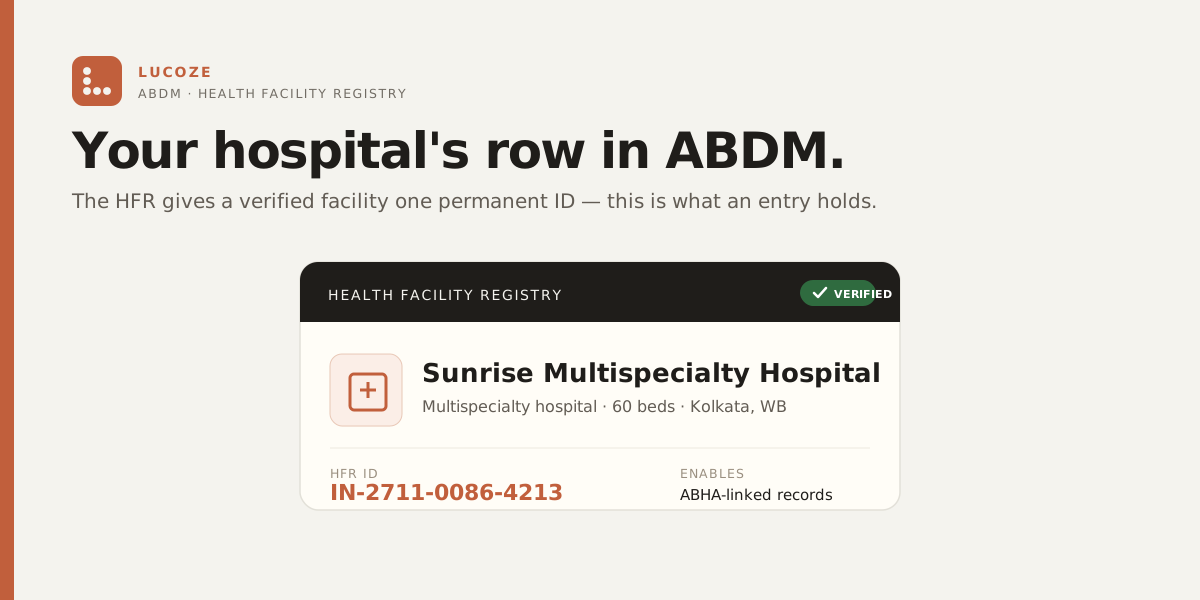
In one line: the Health Facility Registry (HFR) is the National Health Authority’s verified list of health facilities under ABDM, and every registered facility gets a permanent HFR ID — a unique identifier for the place (a hospital, clinic, lab or pharmacy), the facility-side counterpart to a patient’s ABHA. That ID is what lets a facility issue ABHA-linked records and be found inside ABDM.
This is a plain explainer, not official NHA guidance. The portal at facility.abdm.gov.in is the source of truth for current fields, requirements, and any fees.
What does HFR stand for?
HFR stands for Health Facility Registry. It is the official, verified list of health facilities under the Ayushman Bharat Digital Mission (ABDM), run by the National Health Authority (NHA). Every hospital, nursing home, clinic, diagnostic centre, lab or pharmacy that delivers care can hold one entry, each with its own unique facility ID.
The simplest way to hold it: if ABHA is the patient’s health ID, the HFR is the place’s ID. One identifies the person; the other identifies where the care happened.
What is an HFR ID?
When a facility is registered and verified, the HFR issues it a unique HFR ID — a permanent identifier that stands for that facility across ABDM. It does not expire when your staff change or your software changes; it belongs to the facility.
That ID is what actually does the work. With a verified HFR entry, a hospital can:
- Issue records — a discharge summary, a prescription, a lab report — that a patient can pull into their ABHA.
- Be discovered inside ABDM as a real, verified facility rather than a name someone typed.
- Verify other providers and take part in consent-based record exchange on the standard rails.
A concrete version: a 60-bed hospital’s HFR ID is the thing that lets its discharge summary land in the patient’s ABHA instead of a paper folder the patient loses by the next visit.
The HFR portal
Registration and management happen on the HFR portal at facility.abdm.gov.in. You sign in against ABDM (typically with a mobile number and OTP), then create or manage your facility’s entry from there. Portals get redesigned, so treat the exact screens as the shape of the thing and confirm the current flow on the portal itself. If you’re specifically trying to sign in — or can’t get in — we cover the flow and the common login problems in the HFR login guide.
One point of confusion worth clearing: the HFR login is the facility account. The doctors are registered separately, on the HPR (more on that below), and patients create their ABHA on their own — three different registries, three different logins.
Does a hospital actually need to be on the HFR?
If you want any of the things above — issuing ABHA-linked records, being discoverable, joining consent-based exchange, or claiming under schemes and incentives that increasingly assume ABDM participation — then yes. It is fast becoming the price of entry, not a nice-to-have.
And here is the line that trips up procurement: “ABDM-ready” software is not the same as being on the HFR. A vendor can truthfully say their product supports ABDM while your facility still has no HFR entry and issues nothing. The badge is the software’s; the registry entry is yours. Ask for both.
HFR vs HPR vs ABHA — the three you keep hearing together
They are separate registries, and mixing them up is the most common ABDM mistake:
- HFR — Health Facility Registry: registers the facility (your hospital) and gives it the HFR ID.
- HPR — Healthcare Professionals Registry: registers the doctors and clinicians, separately from the facility. See HPR registration for doctors.
- ABHA — Ayushman Bharat Health Account: the patient’s health ID, created or linked at the front desk.
A hospital that is truly on ABDM has all three moving: the facility on HFR, its clinicians on HPR, and ABHAs being created at registration. We go through the whole sequence in the ABDM onboarding process for a provider.
How do you get an HFR ID?
In short: sign in on the portal, enter your facility’s details (type, address, services), complete verification, and the HFR issues your ID — usually the work of an hour, not a project. We walk through it step by step, with what to keep ready, in how to register your facility on the HFR.
Lucoze is built so that once you have the HFR ID, issuing ABHA-linked records is part of the normal workflow — not a second system your front desk has to remember. Data stays hosted in India. If you’d like to see how that fits your hospital, book a demo.
HFR full form and HFR ID — quick answers
What is the full form of HFR? HFR stands for Health Facility Registry — ABDM’s official, verified list of health facilities, run by the National Health Authority. Every registered facility holds one entry with its own unique HFR ID.
What does an HFR ID mean? An HFR ID is the permanent, unique identifier ABDM issues to a verified health facility. It identifies the place — not the patient or the doctor — and is what lets the facility issue ABHA-linked records and be discovered inside ABDM.
Is HFR the same as HPR or ABHA? No. HFR registers the facility, HPR registers the doctors and clinicians, and ABHA is the patient’s health ID. Three separate registries, three separate logins.
Sources
- National Health Authority (NHA) / ABDM portals — facility.abdm.gov.in (HFR), hpr.abdm.gov.in (HPR), and abdm.gov.in. Fields, flows and any fees change by portal update — confirm the current requirements there.